Personal Growth 
Gutted by Guilt: How to Handle Parental Regret
Parental guilt may become an unbearable burden if not addressed biblically. These four simple theological realities help us fight parental guilt.
I can still remember being a boy with a box of old hunting magazines. Outdoor Life. Field & Stream. American Hunter. I wore those pages out.
This was before podcasts and hunting films were always within reach. Those magazines were as close as I could get to the mountains when I was not there. I wanted the miles, the glassing, the stalk, and the moment when everything either came together or fell apart.
For a long time, hunting was mostly about the pursuit. I wanted to improve, go farther, and fill a tag.
As the Lord grew me, and especially as my children began joining me, I started seeing the hunt differently. The animal was not the only thing in front of me. So was a child God had entrusted to my care.
I still prepare for the weather, the terrain, and the animals. But I have learned that a father should also prepare for the person beside him.
Not every father hunts, and I am not arguing that every father should. But every father has places where shared work, recreation, difficulty, and quiet conversation create opportunities to know and disciple his children.
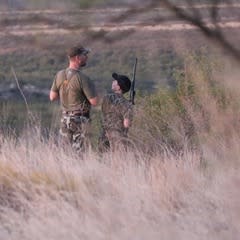
Hunting places people in conditions that are hard to reproduce elsewhere. There are long hours when nothing happens. There are sudden moments when everything happens at once. Fatigue, cold, disappointment, fear, and excitement expose what is going on inside us.
A few years ago, one of my boys was hunting his first Coues deer. We worked through the country all morning and finally reached a good shooting position. We had time, but we knew the opportunity would not last forever.
Then things began going wrong. There were misses. The rifle repeatedly failed to fire because of light primer strikes. We were reloading and trying to diagnose the problem while the deer remained in view. I was giving directions, and some of my directions were not helping.
My son could have rushed, become frustrated, or forced a bad shot. Instead, he listened, stayed steady, and worked through the problem. When the rifle finally functioned correctly, he made a clean shot.
We came home with a deer, but that was not the most important thing I saw that morning. I saw something in my son’s character. I also saw places where I needed to grow as his father.
Hunting has a way of revealing both.
Many hunters prepare carefully for a trip. We study maps, check gear, watch the weather, and think through every possible problem. Yet it is possible to prepare thoroughly for the hunt without giving much thought to the child who is coming with us.
Before heading out, I need to ask more than whether one of my children can handle the miles. What has been happening in that child’s life? What has been discouraging? Is this a time to push a little farther, or does my child need patient encouragement? What kind of example will I give when the plan falls apart?
Ephesians 6:4 places the responsibility on fathers to bring their children up “in the training and admonition of the Lord.” That responsibility does not begin when the Bible is opened for family worship and end when it is closed. Deuteronomy 6 describes God’s truth being passed along in the ordinary movements of life, including when we walk along the way.
For some fathers, that “way” may include a trail, a glassing point, or a dark drive before sunrise.
This does not mean turning every quiet moment into a sermon. Children can tell when we are forcing a spiritual lesson. It means knowing the Word, knowing our children, and being ready when a real opportunity appears.
The goal is not simply to raise tougher or more capable children. It is to help them interpret real life through God’s Word and learn to follow Christ in it.
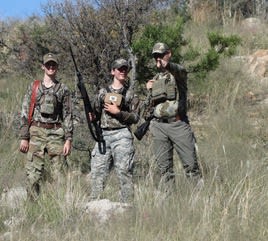
Some of the best parts of hunting seem uneventful. You may sit behind binoculars for hours. You may walk a ridge without seeing an animal. You may spend half a day in a truck getting to the place where the hunt begins.
That is not empty time.

Children, especially as they grow older, often talk more freely when they are beside us rather than sitting across from us. The outdoors slows the pace and removes some of the noise that crowds normal life. A conversation can begin without feeling like an interrogation.
Ask a question, then listen. Talk about what happened that day. Help your child think about what disappointment or fear exposed. A change in weather can open a conversation about God’s care. A successful hunt gives an opportunity to teach gratitude without pride.
The lesson may also require an apology. Our children are watching when we become impatient, make a poor decision, or care too much about success. A father who admits that he was wrong may teach more in that moment than he could have taught through a polished speech.
A filled tag is a good gift. It represents food, work, skill, and a memorable experience. It should be received with gratitude.
But an unfilled tag does not mean the time was wasted. A difficult day can teach perseverance. A missed opportunity can reveal character. The care required after an animal is taken can teach responsibility and the seriousness of taking life. Even an ordinary day outdoors can deepen trust between a father and child.
Your setting may be a ball field, a garage, a fishing boat, a garden, or the passenger seat of your truck. The point is that fathers should recognize the places God has already given them and refuse to move through those experiences without paying attention to the people beside them.
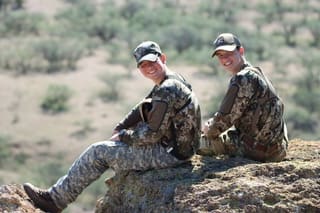
Neither a successful hunt nor a carefully planned conversation can change a child’s heart. Only God, through His Word and by His Spirit, can do that. But a father can use the hours God gives him faithfully.
I still love the pursuit. But when one of my children shoulders a pack beside me, I want to come home having done more than hunted. I want to have known that child better, led more faithfully, and pointed him or her toward Christ. That is what makes it more than the hunt.
Parental guilt may become an unbearable burden if not addressed biblically. These four simple theological realities help us fight parental guilt.
Sin in a family is inevitable. How should we teach our children to deal with their sin?

It's very easy for dads to slip into pursuing the wrong goals in our parenting. Let's explore some of those common unbiblical goals in light of the Bible.

Search by keyword, topic, author, Bible reference and more to find any blog article.
We send once a week and will never share or market your email.
Unsubscribe at anytime.